Then just call me Joe Exotic and my verse cagey tigers.
Netflix jokes aside, I really dig this poetry resource. Poetry as 'performance', I think, serves to bring it out of the learned towers of academia and, in that way, breath life and longevity into it.
Some time ago, I was lucky enough to catch Dana Gioia at a poetry reading hosted by the Dallas Institute. That evening, I witnessed firsthand a master 'performative' poet recite his work to his guest. He looked down only once to his written material. Otherwise he spoke his lines as the living drama that they are. I can't help but think that poetry can act like a thin spot between something like Aristotelian particulars of people in a room (with one man's voice) and Platonic forms of heavenly, language flowers dropping their petals to the here-and-now.
Lately, I've been obsessed with the Lone Bellow's latest album, "Half Moon Light." Alongside Bob Dylan's latest and "Easy Rider: The best of the Mercury recordings" by Johnny Cash, New York's finest country-folk band has my heart and ears. A favorite track titled "Wonder" asks,
"Should I let go of the wonder? Let go of the wonder? I'll find it out beyond the trees."
The question is a good one because it seems to be asking two things at the same time.
What can I keep from the childlike (not childish) awe from before now, when all I got from growing up was getting old?
How am I holding on to an imagined person, place, or thing that isn't leading me to hope and love? Is it best for me to let that go? If so, where will I find the strength to do so? What do I hold on to instead?
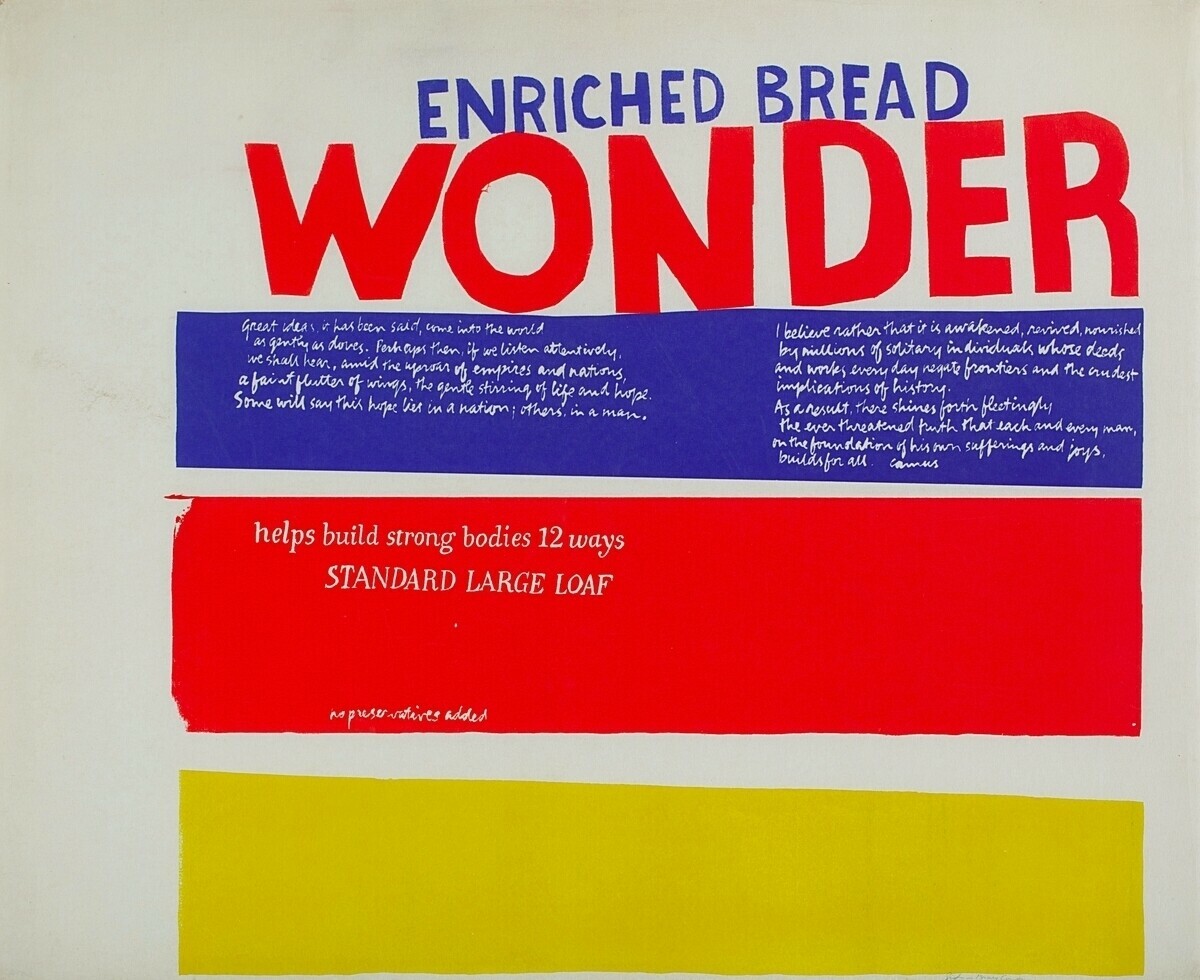
Thinking about wonder and seeing that Austin Kleon was recently asked by the Corita Art Center to speak about Sister Corita Kent in a conversation about her influence on his own work, reminded me of her great collage using Wonder Bread branding (image above). In that collage Sister Kent incorporates a hearty quote from Camus. The tiny script in her collage reads:
Great ideas, it has been said, come into the world as gently as doves. Perhaps then, if we listen attentively, we shall hear, amid the uproar of empires and nations, a faint flutter of wings, the gentle stirring of life and hope. Some will say this hope lies in a nation; others in a man. I believe rather that it is awakened, received, nourished by millions of solitary individuals whose deeds and works everyday negate frontiers and the crudest implications of history.
As a result, there shines forth fleetingly the ever threatened truth that each and every man, on the foundation of his own sufferings and joys, builds for all.
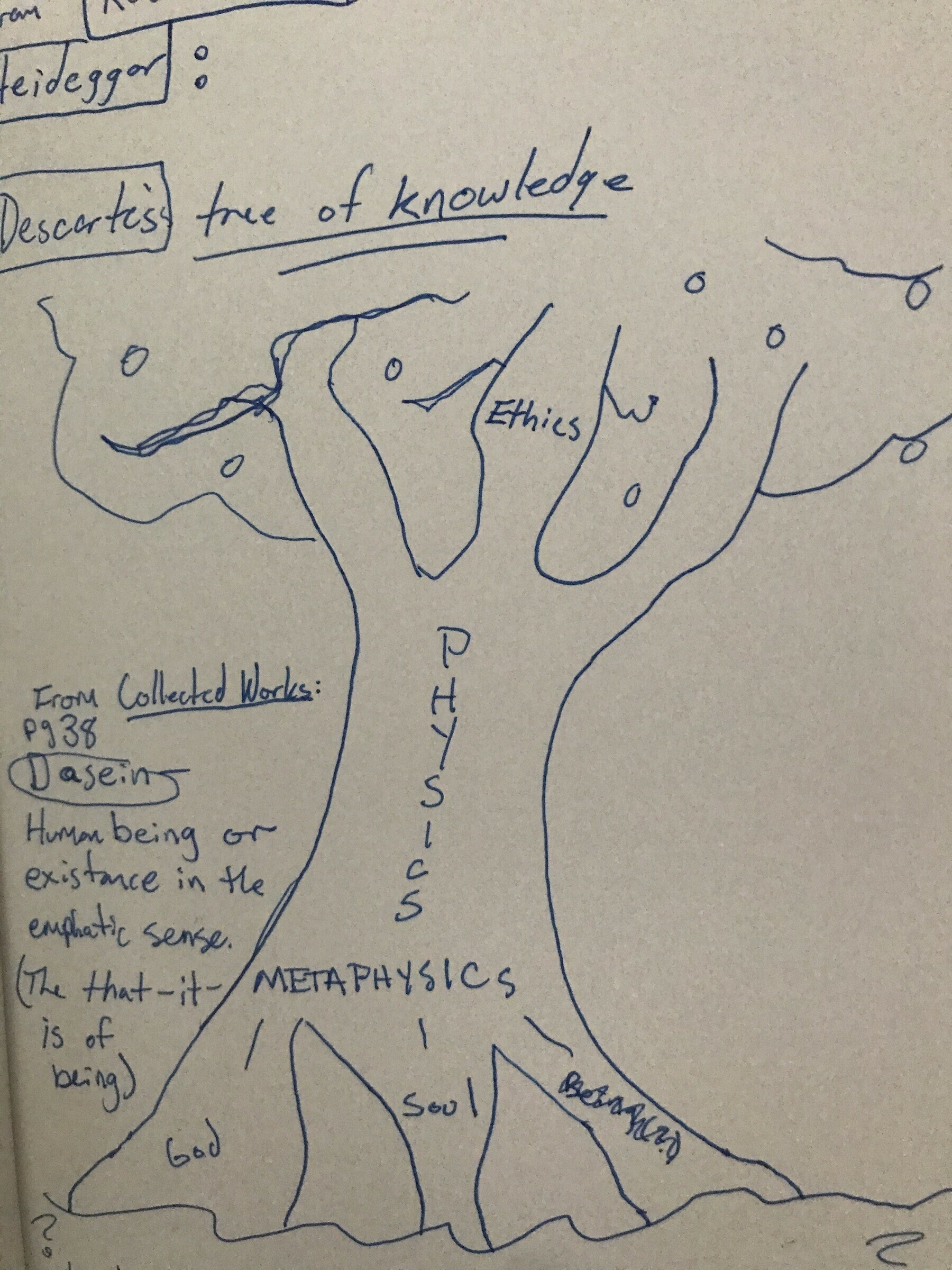
Wood begins his lecture on Heidegger by first illustrating the priority of Renee Descartes's philosophy. He draws a tree on a whiteboard and names some branches.
As Wood draws, he tells the philosophical story that has shaped—how and what we think—us modern folk, and the world in which we find ourselves.
By using Descartes's own 'Tree of Knowledge' illustration, Wood explains Heidegger's priority for tilling the soil in which the tree is planted. Heidegger wants to know what the tree of knowledge is planted in. His answer?
Being in the world. This is the soil. Humanness by virtue of being is the terra firma of knowing. Being is the ground of knowing.
For the Christian, 'being' is of course foundational in the three-person-ness of, "I believe: Father, Son, and Holy Spirit." God is being and he gifts us his being by virtue of his forming us in his image, in the act of creation and Incarnation.
Matthew B. Crawford's Book The World Beyond Your Head has helped me understand this very fundamental fact.
[Of the Cross] Its breadth lies in the transverse beam on which the hands of the Crucified are extended; and signifies good works in all the breadth of love: its length extends from the transverse beam to the ground, and is that whereto the back and feet are affixed; and signifies perseverance through the whole length of time to the end: its height is in the summit, which rises upwards above the transverse beam; and signifies the supernal goal, to which all works have reference, since all things that are done well and perseveringly, in respect of their breadth and length, are to be done also with due regard to the exalted character of the divine rewards: its depth is found in the part that is fixed into the ground; for there it is both concealed and invisible, and yet from thence spring up all those parts that are outstanding and evident to the senses; just as all that is good in us proceeds from the depths of the grace of God, which is beyond the reach of human comprehension and judgement.
St. Augustine: On I John.
"Concealed and invisible" alluding to the depth of the cross—its victim, and work— reminds me of (1)Jesus' and (2)Wendell Berry's words:
"Listen carefully: Unless a grain of wheat is buried in the ground, dead to the world, it is never any more than a grain of wheat. But if it is buried, it sprouts and reproduces itself many times over. In the same way, anyone who holds on to life just as it is destroys that life. But if you let it go, reckless in your love, you’ll have it forever, real and eternal.
Put your faith in the two inches of humus
that will build under the trees
every thousand years.
Listen to carrion — put your ear
close, and hear the faint chattering
of the songs that are to come...Practice resurrection.
It seems like Augustine cannot but help himself from interpreting St John's letter with the language of the apostle of the cross, St Paul. Did Paul have the multi-dimensionality of the cross in mind when he wrote to the Ephesians, Dear Bishop of Hippo?
that you, being rooted and grounded in love, may have strength to comprehend with all the saints what is the breadth and length and height and depth, and to know the love of Christ that surpasses knowledge, that you may be filled with all the fullness of God.
To believe in God means to understand the question about the meaning of life.
To believe in God means to see that the facts of the world are not the end of the matter.
To believe in God means to see that life has a meaning.
—Ludwig Wittgenstein
The Miracle of God's Love
When we come to a point in our lives where we are completely ashamed of ourselves and before God; when we believe that God especially must now be ashamed of us, and when we feel as far away from God as ever in all our lives—that is the moment in which God is closer to us than ever, wanting to break into our lives, wanting us to feel the presence of the holy and to grasp the miracle of God's love, God's nearness and grace.
a book about how Oakland has been shaped by great floods of money and power. It’s a crossroads. Railroad, highway, ocean. Tectonic plates. Social movements. Racial groups. Ideologies.
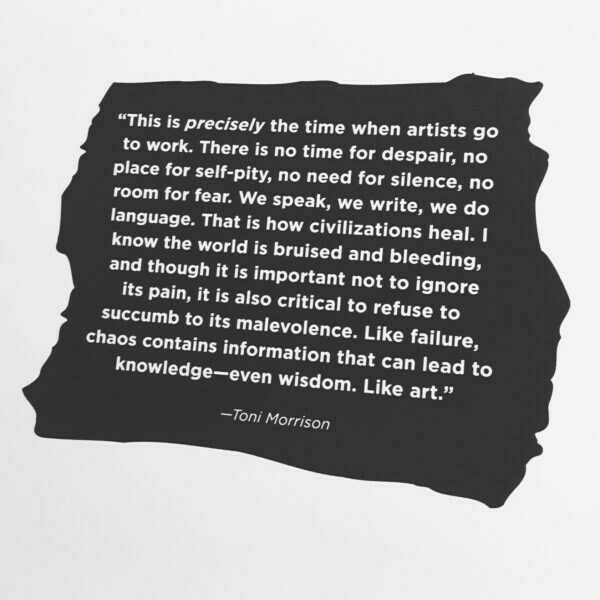
Toni Morrison's "chaos contains...wisdom" idea of growth in despair
AND
Gerard Manley Hopkins poetic line, "Wisdom is early to despair."
Hopkins line comes from his poem "The Leaden Echo And The Golden Echo." In which, he seems to borrow heavily from the Hebrew poet Qohelet, who says this about his work of philosophizing and writing (making art you might say):
So I turned about and gave my heart up to despair over all the toil of my labors under the sun.
We have to recognize that this very act of Qohelet writing his despair is artful. As a product of his salty lament, a book was birthed titled Ecclesiastes.
Toni Morrison, of course, had a very different lived experience from Hopkins (white, Victorian, priest (SJ)) and Qohelet (10th or 3rd C BCE, Hebrew, poet)1 for that matter. And yet, her case for finding wisdom in the midst of despair, harmonizes with the poetic tradition of lament.
Morrison seems to possess a righteous anger that keeps her from strict despair. Instead, she is thrust into lament—dispair with a vocabulary; hurt articulate in wail, "We do language." She gives voice to a primeval wisdom that speaks despair in the midst of chaos and rises on wings of hope into lament that sings. Wisdom rejoices in lament.
The ancient literature of Proverbs tells the story of wisdom in the midst of primordial chaos, in the beginning, at the birth of the world. Here Hokma is personified as the creator's first offspring. Like a protege marveling in the virtuosity of her master teacher, lady wisdom "rejoices" in the work!.
The Lord fathered/created (LXX) me at the beginning of his work the first of his acts of old...When he established the heavens, I was there; when he drew a circle on the face of the deep, when he made firm the skies above...when he assigned to the sea its limit, so that the waters might not transgress his command...then I was beside him, like a master workman, and I was daily his delight, rejoicing before him always, rejoicing in his inhabited world, and delighting in the children of man.
Here is a charge for the artists who weep for injustice and cry for the mercy of justice: In lament and despair, love beauty, make beauty, live and eventually die for beauty.
I'm serious. Husband runs off with a politician? Make good art. Leg crushed and then eaten by mutated boa constrictor? Make good art. IRS on your trail? Make good art. Cat exploded? Make good art. Somebody on the Internet thinks what you do is stupid or evil or it's all been done before? Make good art. Probably things will work out somehow, and eventually time will take the sting away, but that doesn't matter. Do what only you do best. Make good art.