Some time ago, a small detail from the Road to Emmaus story in Luke's Gospel surprised me. It occurred to me that the theme of "new" exodus which is vital to Luke's telling of what Jesus came to do, finds a climax in the Road to Emmaus. Let me explain.
The two travelers walk from Jerusalem and discuss the report that some folks saw the tomb empty, in addition to angles who said Jesus is alive. While they travel, a man they don't recognize (who Luke narrates is Jesus) joins them. He inquires as to the topic of conversation. Cleopas explains and the stranger takes the news in stride. Without browbeating as to who he is, Jesus proceeds to cite evidence from the Hebrew bible that it's all true of him. He says:
"Was it not necessary that the Christ should suffer these things and enter into his glory?"
After which Luke picks up narration:
And beginning with Moses and all the Prophets, he interpreted to them in all the Scriptures the things concerning himself.
Here's what I learned.
Cleopas and possibly his wife, as two representative disciples, journey west toward a new, recreated world having the true story of redemption and forgiveness recounted to them, by Jesus. Since Adam and Eve were exiled to the east from the garden, humankind suffers to be back with God. He comes to us. Not since Adam and Eve has a couple walked with God out from exile into new creation. He frees us to travel through the ordeal into eternal rest with him, in the City of God. The way has been given.
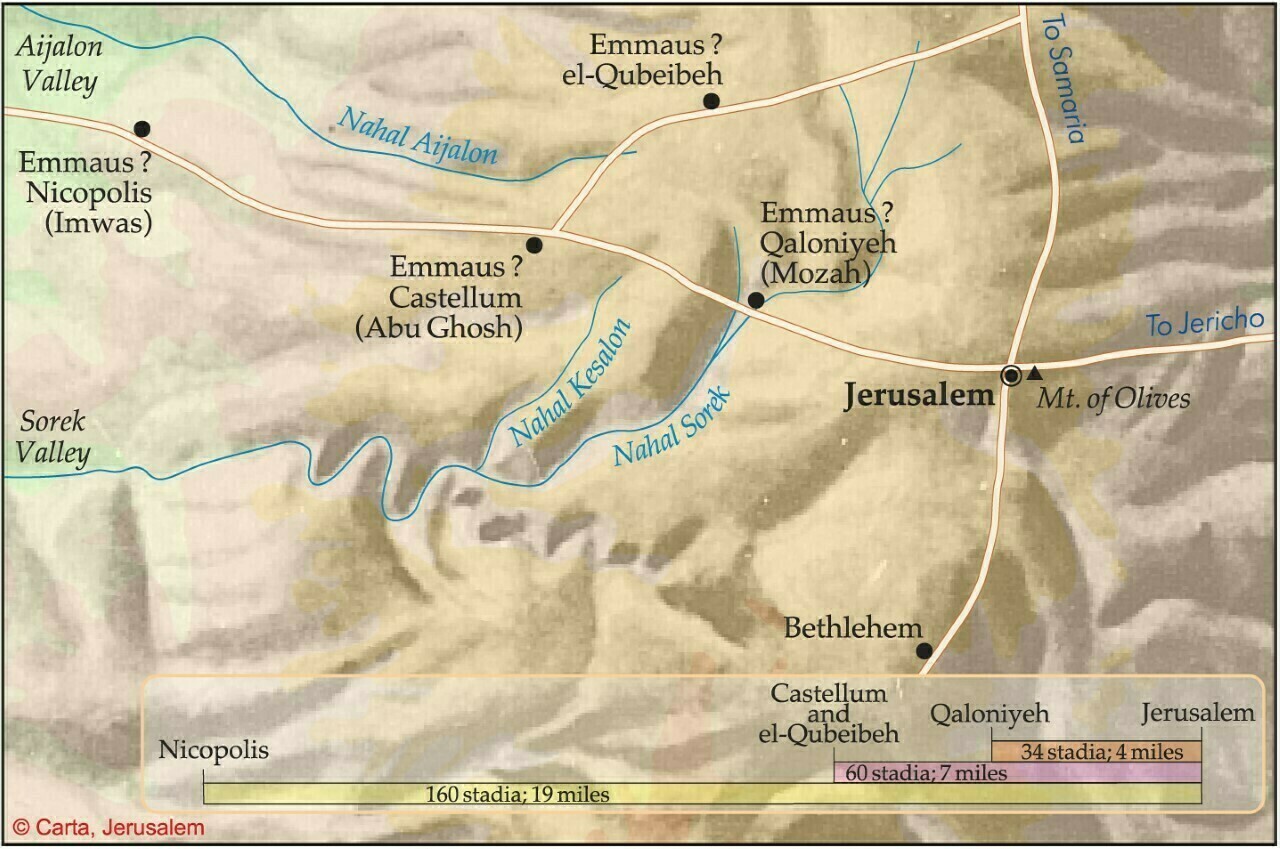
Of course we can't know for certain where the city or village of Emmaus stood. However, the map below offers three possible sites of the historical Emmaus, all of which sit west of Jerusalem. While it's true that the two travelers return east to Jerusalem to share the good news of Jesus' appearance, this, theologically, fits with the centripetal, sending nature of God—an incipient story of the command to go and initiate disciples into the community with a God bath.
I say that not only they who labor for the defense of the gospel but they who in any way maintain the cause of righteousness suffer persecution for righteousness. Therefore, whether in declaring God’s truth against Satan’s falsehoods or in taking up the protection of the good and innocent against the wrongs of the wicked, we must undergo the offenses and hatred of the world, which may imperil either our life, our fortunes, or our honor.
Here is a meeting made of hidden joys
Of lightenings cloistered in a narrow place
From quiet hearts the sudden flame of praise
And in the womb the quickening kick of grace.
Two women on the very edge of things
Unnoticed and unknown to men of power
But in their flesh the hidden Spirit sings
And in their lives the buds of blessing flower.
And Mary stands with all we call ‘too young’,
Elizabeth with all called ‘past their prime’
They sing today for all the great unsung
Women who turned eternity to time
Favoured of heaven, outcast on the earth
Prophets who bring the best in us to birth.
I love reading about the lives of the Inklings—the 20th century group of Oxford eccentrics. Some time ago I came across this website of quotes culled from two seprate devotional books collected by Charles WIlliams. Since I added the feed to my RSS Reeder, the snippets act like the best kind of desk calendar full of dank quotes each new day. Here’s two Pentacost Sunday gems:
A gift is properly an unreturnable giving … hence it is manifest that love has the nature of a first gift, through which all free gifts are given. So since the Holy Ghost proceeds as Love, He proceeds as the first gift. Gift … is the proper name of the Holy Ghost.
Thomas Aquinas: Summa Theologica.
The Holy Ghost is He whereby the Begotten is loved by the One begetting and love His Begetter.
Concerning social memory in particular, we may note that images of the past commonly legitimate a present social order. It is an implicit rule that participants in any social order must presuppose a shared memory. To the extent that their memories of a society’s past diverge, to that extent its members can share neither experiences nor assumptions.
— Paul Connerton, How Societies Remember
Today, M. Sacasas reminded me that the one thing we, the people, might collectively do, as a united whole, is lament —be sad, together. It’s not easy work.
This morning a listened to a podcast discussion on the work of Hans Urs von Balthasar that sadly seems to be inactive. Despite truncated production, the one episode that was published gave an invigorating introduction to Balthasar’s book Christian Meditation. From which, the hosts highlight VB’s theology of meditation, IN Christ. I have two takeaway thoughts and one takeaway prayer:
Thomas Torrance’s The Mediation of Chirst might make a great reading companion to VB’s Chirstian Meditation for their mutual, high christology. Torrance holds a reformed catholic view of the atonement that leaves much to mystery, while staying firmly trinitarian in upholding the hypostatic union. Jesus the Christ is cosmically inclusive by way of his exclusice mediation on the cross. In a similar way, VB maintains the particular mediation by the person of Christ, in prayer. By Christ’s mediation, one does not empty the mind in order to incite God to come near. Rather, Jesus prays for us as the incited action of God, particularly when he came near in space and time to pray for us in death (Lord, Jesus, pray for me now and in the hour of my death). “Why am I forsaken,” can only be prayed by Christ on his cross.
VB and Torrance might hug or, at least shake hands, in saying: even now, the risen, slain-Lamb is behind the veil, praying to his father, in the love of the Spirit, for his people.
Prayer is inviting one’s soul into the presence of Chirst and finding one’s home in the triune God. AND Prayer is kneeling, at the trough of our sin, sadness, misery, and self-love, in/with Christ, long enough to find satisfaction in a father already running to meet us—coming to our senses…in the words of George Herbert, “Something understood.”
Our Father, in whom we surrender our perceived control, your self-revelation is heavy with value. Please bring your crowned king to rule, here and now, like it is there and always, in heaven. Give us grace enough for our next breath and decision, in remembrance of you. Please wash us with the clensing blood of your son, Jesus, as we wash others with the water of your word. Don’t steer us into the songs of the Sirens but sail us away from the rocks into the open sea of your love. Because we journey, fight, and serve your purpose, by your strength, and for your praise. Amen
OSDB Sports is a new startup that, as the the name suggests, acts as an IMDB for sports. An interesting concept that enables players, unions, teams, and leagues democratized space to tell stories and share conent. I wonder if it will catch-on with fans in a way that other sports platforms have struggled to.
Book Recommendation 📚 Challenge Sprint: 6 and 7
The Man Who Was Thursday —G.K. Chesterton The Power and The Glory —Graham Greene
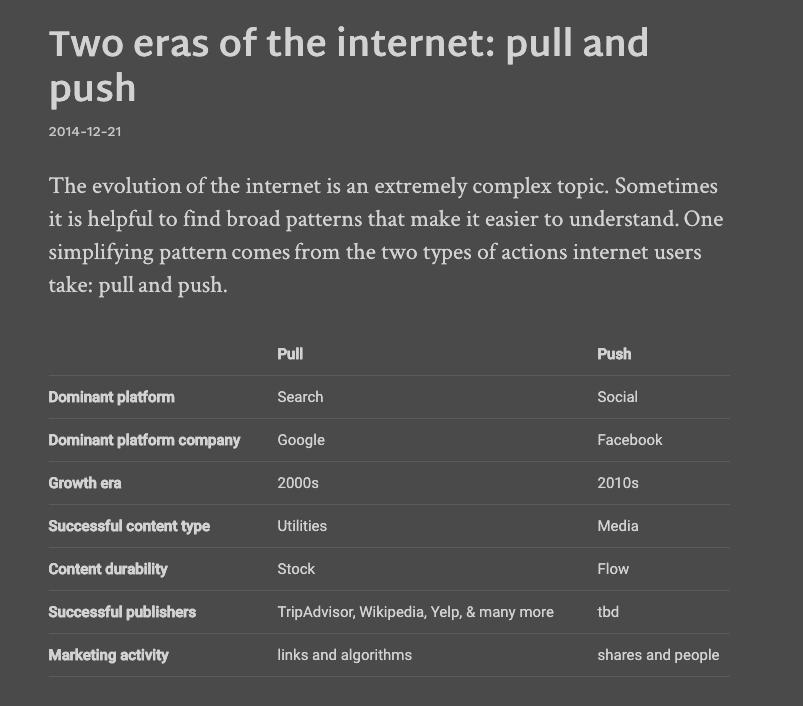
“Push and Pull” are Chris Dixon’s simplifying patterns of the internet named for the action that users enact on the tool. “Push and pull” classifies how we lay claim and opt-into the digital world.
This participation with the internet reminds me of what ends up shaking out over time and what Austin Kleon calls “Stock and Flow.” In fact, Dixon categorizes push and pull as stock and flow, respectively, under the category of “Content Durability.” To help us understand content durability here are Robin Sloans’ defenitions of flow and stock:
Flow is the feed. It’s the posts and the tweets. It’s the stream of daily and sub-daily updates that reminds people you exist.
Stock is the durable stuff. It’s the content you produce that’s as interesting in two months (or two years) as it is today. It’s what people discover via search. It’s what spreads slowly but surely, building fans over time.